When you leave hospital, the discharge summary written about your stay acts as the bridge between the hospital and your GP. These often involve requesting your GP to perform some follow-up action, e.g. “check bloods in 1 week,” or “review medication”.
But these aren’t always followed.
In my new HDR UK poster, I explored if the language used by hospital clinicians affects this. The result? While politeness doesn’t make a difference, language precision does, and that an AI model can predict which follow-up requests are likely to be missed.
The Problem
Hospital discharge summaries often include requests for primary care, e.g. “check bloods in 1 week,” “review medication,” and so on. But studies show that these actions are inconsistently followed.
Sometimes the request seems unnecessary, sometimes the patient doesn’t attend, and sometimes the workload in primary care just makes it hard to keep up.
We wanted to know:
- Does the way a request is written affect whether it’s completed?
- Can AI help identify which requests are at risk of being missed?
Some Data
We gathered thousands of discharge summaries from Salford Royal Hospital, and used a langauge model to extract requests from the text:
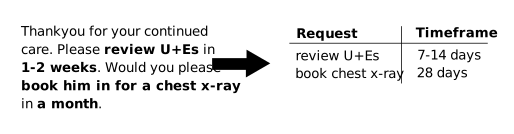
We can then compare the requests to primary care records to see if and when any blood tests were actually done:
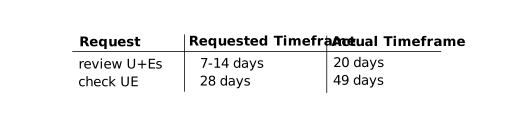
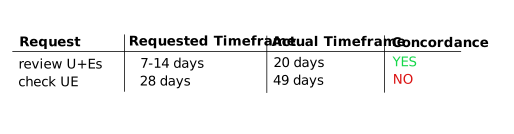
We label any requests where the blood test is done within 7 days of the requested timeframe as “concordant”:
Predicting Concordance
Now we have a dataset of requests and concordance, we can train a model.
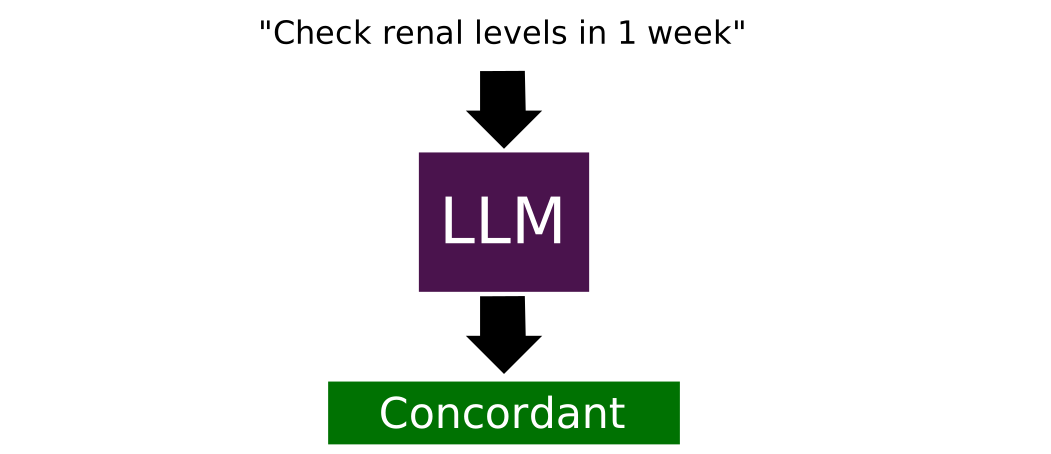
The model predicts concordance directly from request text with 83% accuracy.
These metrics indicate that on internal validation, the model utilising linguistic features was both accurate and robust.
Investigating the patterns the model learned, we found that:
- Precise, clinical language (words like “renal,” “potassium,” “kinase”) predicted higher follow-through.
- Conditional or vague terms (“if possible,” “consider checking”) predicted non-concordance.
- Surprisingly, words of gratitude (“thanks,” “thank you”) often appeared in requests less likely to be completed, possibly because they softened uncertain or tentative instructions.
Why it matters
The fact that we can accuratly predict concordance suggests that how we write discharge summaries affects how care is delivered.
More importantly, an AI model can flag which requests are unlikely to be actioned, allowing clinicians to write better discharge summaries.
Imagine an EPR system that quietly warns:
“This request is phrased in a way that historically leads to low follow-through.”