How it Works
Many multimodal systems use separate encoders, modality-specific architectures, or cross-modal fusion modules. instead let's represent text, images, audio, and video in the same format: a sequence of visual frames. A single model is then trained to predict the next frame.
Everything is a video.
The reformulation is applied to each modality as follows.
Text
For text, each token is rendered as one video frame using a fixed-width font scaled to fill the frame:
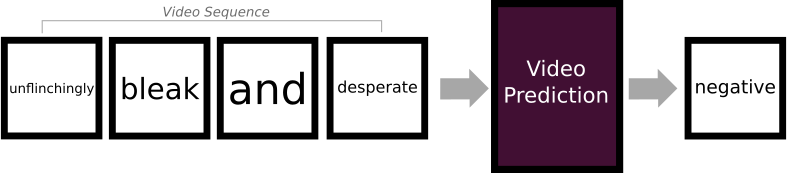
The same representation can be used for text generation, question answering, and other text tasks.
Audio
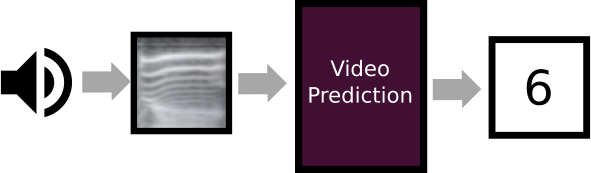
For audio, the waveform is converted into spectrograms, which represent frequency content over time:
Images
An image is treated as a single video frame:
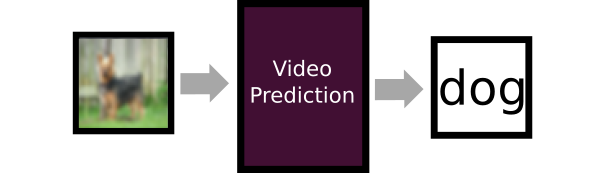
This representation can also be used for image generation, inpainting, and related tasks.
Multimodal
Multiple modalities can be combined in one video stream. For example, CLEVRER video question answering (video + text -> text) can be formulated as video prediction:

The same format can represent other modality combinations, such as video captioning (video + audio -> text).